
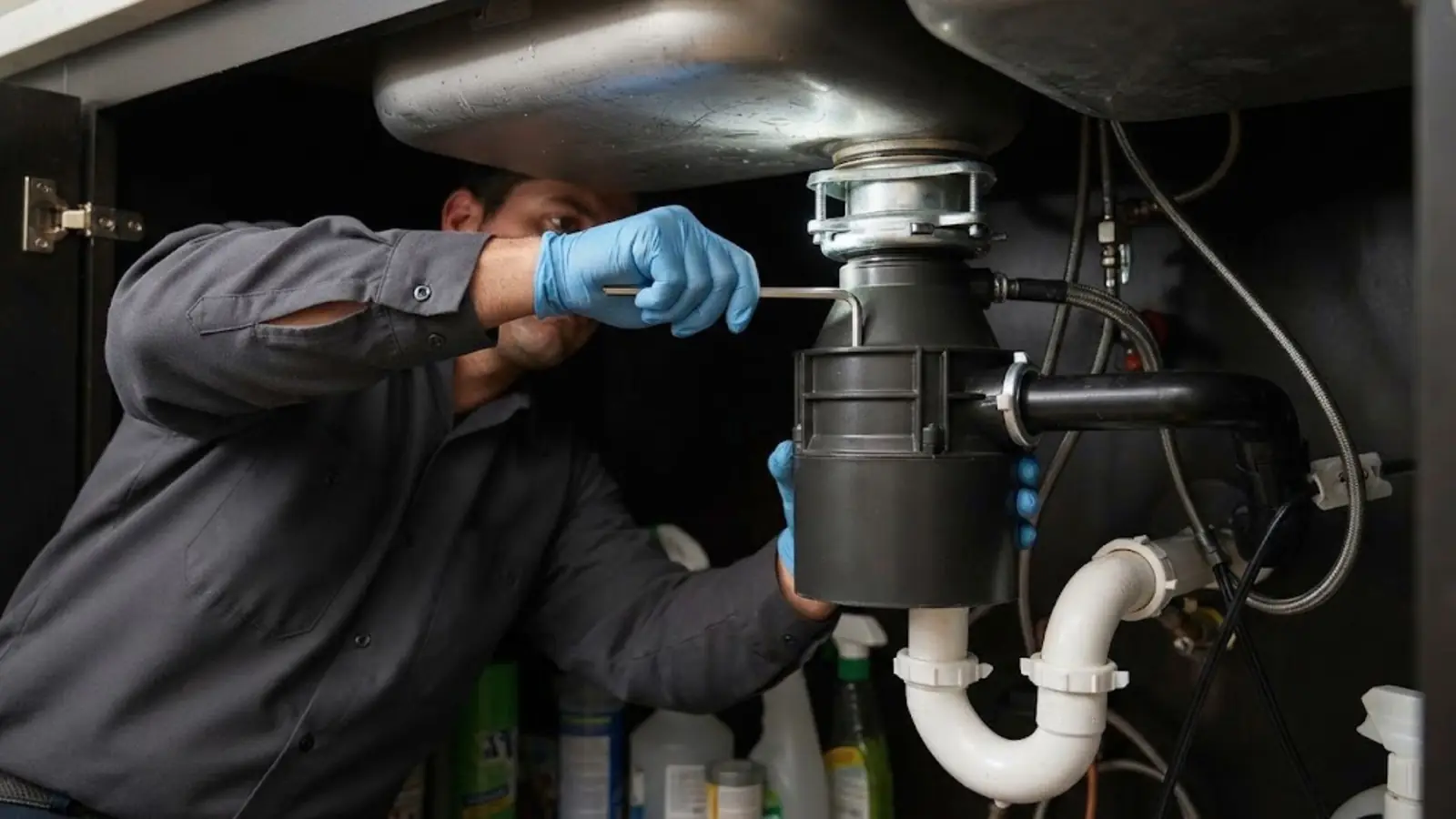
Humming but not spinning: the jam
A disposal that hums but does not spin is jammed. Something hard, such as a bone, a fruit pit or a bottle cap, has wedged the grinding plate. Switch the unit off at the wall switch before you do anything else. Under the unit, a hex socket in the bottom lets you turn the motor by hand with a hex key, which frees most jams.
Never put a hand into the disposal, even when it is off. If the reset button on the bottom has popped, press it after the jam is cleared and the motor has cooled. If the unit still hums or trips again, the motor or the wiring may be at fault and it is time for a plumber.
Disposal problems and likely causes
Most failures look a lot alike from the sink. This table shows how we sort them.
| Symptom | Likely cause | Typical fix |
|---|---|---|
| Hums, no spin | Jammed grinding plate | Free with the hex key, reset the unit |
| Silent, no hum | Tripped reset or dead power | Reset, check the switch and outlet |
| Leaks from the top | Failed sink flange seal | Reseat the flange with new putty or gasket |
| Leaks from the side or bottom | Cracked housing or bad internal seal | Replace the unit |
| Drains slowly | Clogged drain line or a bad trap | Clear the line, see drain cleaning |
Leaks: top, side or bottom
Where the leak appears tells you what failed. Water at the top comes from the flange where the disposal meets the sink, and a new seal usually fixes it. Water from the dishwasher hose connection is a loose clamp or a cracked hose. Water from the bottom or the side means the housing has failed from corrosion, and replacement is the only repair.
Dry the cabinet, run the disposal with a little water and watch where it shows. A paper towel pressed to each joint helps you see which joint is the source. A leak that has been running for some time may have damaged the cabinet floor, which we check before we leave.
Choosing a replacement
Disposals are rated by horsepower, and for most households a half to three-quarter horsepower unit is enough. A larger motor grinds finer and quieter but costs more. Continuous-feed units run while the switch is on. Batch-feed units run only with the stopper in place, which some families prefer for safety.
Mounting systems differ by brand, and a new unit does not always fit an old flange. We bring the common adapters. If the sink drain behind the disposal is old or slow, we replace it at the same time, since a new disposal on a clogged line will back up quickly.
What belongs in a disposal and what does not
A disposal handles soft food scraps well and hard or fibrous items poorly. Celery, corn husks, potato peels in quantity, coffee grounds and eggshells all contribute to clogs in the drain line, not in the disposal itself. Grease is the worst offender, because it coats the pipe downstream and hardens.
Run cold water for a few seconds before and after use so waste moves down the line. Citrus peels freshen the unit, and ice cubes do little to sharpen it. If your kitchen drain clogs more than once a year, the line behind the disposal deserves a look.
Disposal humming, leaking or dead?
Call us and describe the sound. We often tell you what to try on the phone.
What affects disposal repair and replacement pricing
We explain the price before work starts.
Insurance seldom covers a worn disposal, though a sudden leak that damages cabinets may qualify. Call (208) 679-8357 for a clear price. Plumbing connections follow the Uniform Plumbing Code (UPC), and any new wiring follows the National Electrical Code (NEC).
Garbage disposal questions from Post Falls homeowners
Often yes. Turn off the power, turn the motor by hand with the hex key at the bottom and press the reset button. Never put a hand in the unit. If it keeps jamming, call us.
It varies with use and water conditions. A unit that is leaking from the housing or tripping often is near the end.
Yes. We check that it fits your mount and that the drain and power are suitable.
That usually points to a clog in the line behind the unit. See drain cleaning.
Yes. We add the outlet, the switch and the plumbing modifications. Wiring work follows local code.