
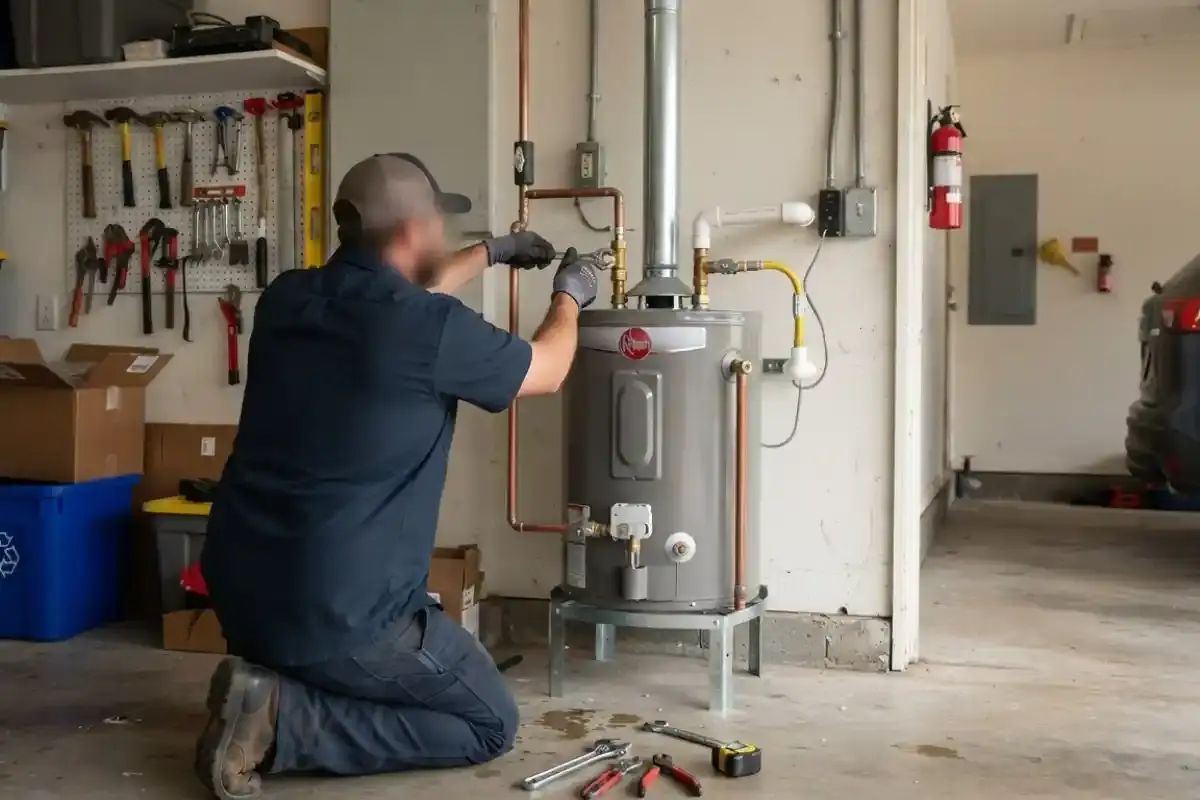
Start here: is it a repair or a replacement?
Most repair calls come down to one question: is the failure a small part or the tank itself? Heating elements, thermostats, gas valves, thermocouples, igniters and relief valves are all replaceable. A leak from the tank body is not, because once the steel liner has rusted through, no fitting stops it.
A heater in good condition with a single failed part is usually worth fixing. A heater that is well past a decade old, rusted at the base and failing for the second time in a year usually is not. We will tell you which category yours falls into, and if replacement is the sensible call we hand you over to our water heater replacement crew rather than sell you a repair that will not last.
What to do when a failing water heater is an emergency
Treat water around the base of a tank as urgent. A weeping fitting is a small repair. A steady drip from the tank bottom or a puddle that grows is a failing tank, and a tank that has lost its liner can release the whole forty or fifty gallons at once.
- Turn the cold water supply valve on top of the heater to the off position.
- For an electric unit, switch off the breaker so the elements are never energized dry.
- For a gas unit, turn the gas control to pilot or off and open a window if you smell gas.
- If you smell gas, leave the house and call the gas utility or 911 first, then us.
- Move stored items away from the tank and photograph any water damage.
If you have no hot water but see no leak, you can wait for a same-day visit. If you smell rotten egg or gas near a gas heater, leave and call the utility before anyone touches the unit.
Symptoms and what they usually mean
Each of these is a common reason for a service call. The right fix depends on a short diagnosis, so use this as a guide, not a substitute.
Lukewarm water that runs out fast
Often a failed lower heating element on an electric tank, or sediment insulating the burner on a gas tank.
Pilot will not stay lit
A worn thermocouple, a dirty pilot assembly or a failing gas control valve. Gas units only, and sometimes a draft problem.
Popping or rumbling noises
Sediment baked onto the bottom of the tank. A flush may help early. Heavy buildup shortens tank life.
Water leaking from the top
Usually a loose inlet or outlet fitting or a leaking relief valve. Often repairable.
Water leaking from the bottom
The tank itself, or the drain valve. Check the valve first, but a leaking tank means replacement.
Rusty or smelly hot water
A depleted anode rod can let the tank corrode and feed bacteria that smell like sulfur. Rods can be replaced.
Gas, electric and hybrid units each fail differently
Gas heaters depend on a flame, a venting path and a control valve. Their problems tend to be ignition problems, such as a dirty pilot, a weak thermocouple or a draft that blows the flame out. Electric heaters have two elements and two thermostats, and a single dead element will cut capacity roughly in half without any visible sign.
Hybrid heat pump heaters add a compressor, a fan and an air filter that needs cleaning. They are efficient but sensitive to a closed, cramped utility closet, since they need room to pull heat from the surrounding air. If a hybrid in a tight space is running only in resistance mode, the fix may be airflow rather than a part. Tankless units follow their own rules, and our tankless water heater page covers descaling and error codes.
Typical repairs and how long they last
Costs are always quoted after diagnosis. This table is about expectations, not prices.
| Repair | Usually worth it when | Think twice when |
|---|---|---|
| Heating element or thermostat | Tank is under ten years old and not leaking | Tank is old and has a second element near failure |
| Thermocouple or igniter | Gas tank with no rust at the base | Burner assembly is heavily corroded |
| Relief valve or fittings | The tank itself is dry and sound | Water is also coming from the tank body |
| Anode rod replacement | Tank is middle-aged and clean inside | Tank is already leaking or badly scaled |
Permits and codes when a repair becomes a replacement
Repairing a part inside an existing heater does not usually involve the city. Replacing the tank does. The City of Post Falls Building Division issues plumbing permits and inspects the work, and the state plumbing code in force is the 2017 Idaho State Plumbing Code, which is based on the 2015 Uniform Plumbing Code. Permit rules vary by job, so ask the Building Division at (208) 773-8708 if you are unsure whether your work needs one.
That code matters in small details such as the relief valve discharge line, seismic or strap requirements where they apply, and the clearance around combustion air. A good repair respects them even when no inspector is watching.
No hot water tonight?
Call the emergency line. We offer same-day appointments when the schedule allows, and the line is staffed after hours.
What affects a water heater repair price
A clear price comes before any work begins. The factors below are what move it.
Standard homeowners policies usually cover a sudden tank rupture that damages the house but not the heater itself. Keep photos and the invoice. Call (208) 679-8357 for your real number. Relief valves, venting and gas connections follow the Uniform Plumbing Code (UPC) and the manufacturer instructions.
Water heater repair questions from Post Falls
Yes. A leaking tank or a total loss of hot water can be reported at any hour on the 24/7 line. We dispatch a licensed plumber, and when the tank is leaking we tell you how to shut off the water and power while you wait.
On electric tanks the usual causes are a tripped breaker, a failed element or a bad thermostat. On gas tanks it is usually the pilot, the thermocouple or the gas control. A short diagnosis finds which one.
Dry the base, watch for new moisture over an hour and check the fittings at the top and the drain valve. If water keeps appearing at the bottom and the fittings are dry, the tank is failing.
There is no single number, but tanks nearing or past the ten to fifteen year range tend to fail again soon after a repair. We look at the condition of the tank and the cost of the fix, not just the age on the label.
Yes. Tankless units mostly need descaling and sensor work, and hybrids need airflow and filter checks. See our tankless page for the details.
A part swap inside the heater generally does not need a permit, but replacing the heater does. Permit rules vary, so check with the Post Falls Building Division at (208) 773-8708.