
Water spreading or a meter that will not stop
If you can see water moving through a ceiling, a wall or a floor, treat it as an emergency. Close the main shutoff, switch off power to the wet area if you can do it without touching standing water, and call. A ceiling that bulges with trapped water can drop without warning, so keep people out from under it.
- Shut the main water valve and open a low faucet to drain the lines.
- Move furniture and electronics away from the wet area.
- Photograph the damage before anything is cleaned or removed.
- Write down the meter reading so we can confirm whether the leak stopped.
Is the leak really there? The meter test
Before any equipment comes out, a simple meter test tells you whether water is leaking at all. Turn off every fixture, appliance and ice maker, then look at the leak indicator on the water meter. If the small dial or triangle keeps moving, water is going somewhere. If it stands still for fifteen minutes, the problem is probably not a pressurized supply line.
A moving meter with nothing running splits the problem in two. The leak may be inside the house, or it may be on the buried line between the meter and the house. Closing the main valve at the house and checking the meter again answers that question, and it tells us where to start.
High water bill with no obvious cause
A bill that jumps for no visible reason is one of the most common reasons people call. A running toilet can waste a surprising amount in a day, and a leak in a buried line wastes more and shows nothing on the surface. Seasonal irrigation, a new household member or a filled pool can also raise a bill without any leak at all.
We start with the meter test and a walk through the fixtures, and then move to listening equipment if the cause is still unclear. If the City water account shows a sudden change, the Post Falls Water Division at (208) 777-9857 can tell you what the meter recorded. A leak found early often costs a fraction of the water it would waste in a season.
Where hidden leaks hide and how we find them
Different locations call for different methods. This is the order we usually work in.
| Location | Typical signs | Method |
|---|---|---|
| Under a slab or in a crawlspace | Warm floor spot, musty smell, meter moving | Acoustic listening and pressure isolation |
| Inside a wall or ceiling | Stain, bubbling paint, sound of running water | Moisture meter and thermal imaging, then a small access cut |
| Buried line outside | Soggy ground or a green patch, low pressure | Zone isolation and ground microphone sweep |
| Irrigation or pool supply | Wet lawn at odd hours, bill higher in summer | Pressure test of the zone valves and the pool fill line |
| Fixtures and appliances | Drip under a sink, damp cabinet floor | Visual inspection and dye or paper test |
Acoustic leak detection, in plain terms
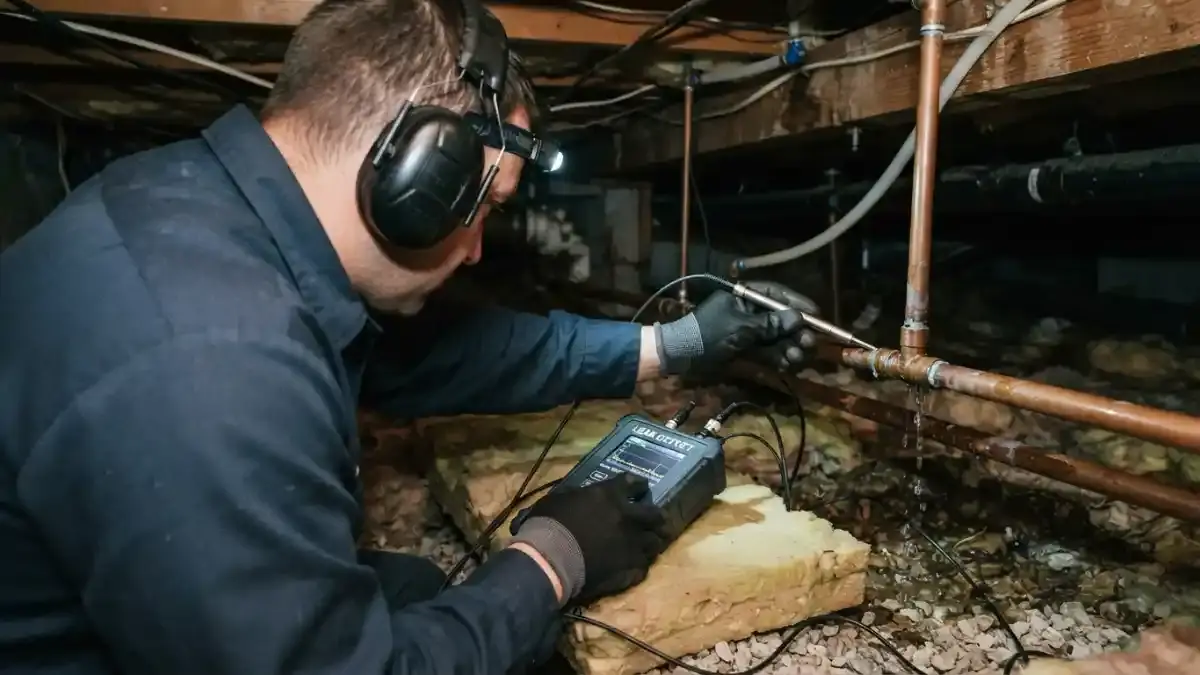
Pressurized water makes a distinct hiss as it escapes a pipe. A sensitive microphone on the floor or a pipe fitting picks up that sound, and the strongest point on the sweep marks the likely location. The method works best on pressurized supply lines and less well on drain lines, which carry water only part of the time.
Noise from traffic, appliances or a nearby irrigation system can mask the signal, so we often work in the quiet of the early morning or ask you to shut off nearby fixtures. When the sound alone is unclear, we confirm with a pressure test. If the point is under a slab, we mark it and discuss the repair options before anyone breaks concrete.
Slab leaks and crawlspace leaks
A leak in a slab foundation is a different problem from a leak in a crawlspace. In a slab, the water line runs under concrete, and a pinhole in a copper line can leak for months before it shows as a warm patch or a damp carpet edge. In a crawlspace you can often see and reach the pipe, which makes the repair simpler.
When a slab line has failed, the options are to open the slab and repair the section, reroute the line through the walls or attic, or replace the whole line. The best choice depends on the age and material of the pipe and on how many leaks have already appeared. If the pipe is failing in several places, our repiping page explains why a reroute may cost less than repeated repairs.
Think you have a hidden leak? Call us
Our dispatch line is open around the clock. Describe the stain, the sound or the bill and we will tell you what to check first.
What affects leak detection pricing
We explain the price before work begins. The number depends on the following.
Many homeowner policies pay for sudden water damage but not for the repair of the pipe itself. Ask your insurer before you start, and keep the report we give you. Call (208) 679-8357 for your own number. Repairs that follow a leak search are made to the Uniform Plumbing Code (UPC) and permitted where required.
Leaks around the Rathdrum Prairie
Post Falls sits over the Spokane Valley Rathdrum Prairie aquifer, and the soil here is gravelly, which drains water away quickly. That is good for drainage and bad for finding leaks, because water from a buried line can disappear down through the gravel without ever reaching the surface. A lawn that stays dry is not proof that the line is sound.
Winter adds another cause. Ground freezing and thawing can shift buried fittings, and a line that has been stressed in one cold season sometimes shows up as a leak in the next. If a frozen pipe has already burst inside, see our burst pipe repair page for the emergency steps. For a leak in the line between the meter and the house, water line repair covers the options.
Leak detection questions from Post Falls homeowners
Yes. The 24/7 line is answered at all hours. We send a licensed plumber, and we talk you through shutting the water off while we travel.
Common signs are a rising water bill, a meter that moves when everything is off, damp or warm spots on floors, musty smells and the sound of running water at night.
Not always. Listening equipment and thermal imaging often narrow the search to a small area. When access is needed, we open the smallest hole that works and tell you before we do it.
Policies differ. Many cover sudden water damage but not the repair of the failed pipe or damage from a long-term leak. Ask your agent and keep the report.
Yes. We test the zone valves and the supply line to the system. A broken head or a buried fitting is often the source of a wet lawn.
Drain leaks are found with a camera and, in some cases, a water test. See our sewer inspection page for how we do it.