
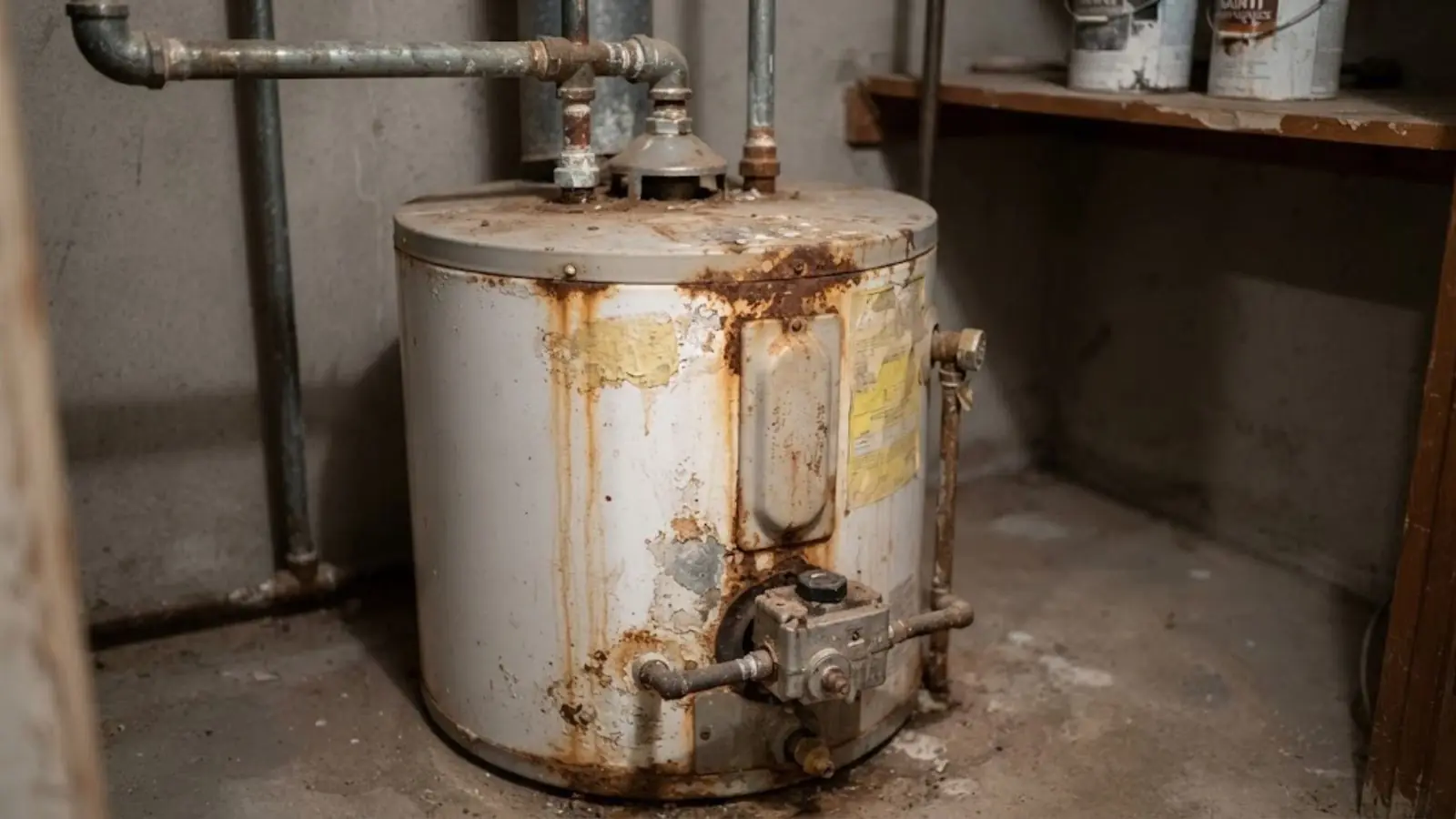
A tank that has failed: the first hour
A leaking tank is a one-way problem. Close the cold water valve above the heater, switch off the breaker or turn the gas control to off, and open a hot tap somewhere in the house to relieve pressure and let the tank drain. If the leak is heavy, attach a hose to the drain valve and run it to a floor drain or outside, keeping clear of hot water.
Do not try to patch the tank. Water that reaches the steel through a corroded liner cannot be stopped from outside, and a patched tank can fail without warning. Once the supply is closed and the power is off, the situation is stable and you can wait for a same-day replacement instead of rushing a decision.
Picking the replacement: size, fuel and type
Sizing starts with how many people use hot water at the same time, not with the size of the house. A household of one or two often does well with a forty gallon tank. Four or five people with two bathrooms usually want fifty to sixty-five gallons, or a tankless unit rated for the number of fixtures that run at once.
Fuel is the second choice. A gas heater recovers fast and costs less to run where natural gas is available, but it needs a flue, combustion air and a gas line in good shape. An electric tank is simple to install and has no venting.
A hybrid heat pump heater uses far less electricity but needs open space around it and produces cool, dry air as it works. If you are weighing a switch from a tank to an on-demand unit, our tankless water heater page lays out the tradeoffs.
Which type fits which home
No single type is right for everyone. These are the patterns we see most often when homeowners ask for a replacement.
| Type | Good fit | Watch for |
|---|---|---|
| Standard gas tank | Homes with an existing gas line and flue, higher hot water demand | Venting condition, combustion air and a gas shutoff within reach |
| Standard electric tank | Homes without gas, garages and utility closets with no flue | Slower recovery, circuit size and breaker rating |
| Hybrid heat pump | Larger rooms with open airflow, higher electric rates | Clearance, condensate drain and a cooler room while it runs |
| Tankless gas or electric | Steady demand, limited floor space, long-term plans | Gas line size or electrical load, venting and annual descaling |
What a code-ready replacement includes
A proper replacement is more than swapping a tank. The cold supply and the hot outlet get new connectors with a shutoff, a temperature and pressure relief valve with a discharge line run to a safe termination, and a drain pan where leaks would damage a finished floor. Where the home has a closed system with a pressure reducing valve or a check valve at the meter, a thermal expansion tank is added so heated water has somewhere to go.
The work follows the 2017 Idaho State Plumbing Code, which is based on the 2015 Uniform Plumbing Code. In Post Falls the City Building Division issues the plumbing permit and does the inspection at 408 N Spokane Street. In Coeur d'Alene the city also lists water heater replacement as permit work, and it can often be permitted over the counter. We pull the permit, so the inspection does not become your project.
Before we arrive, you can speed things up
A little preparation shortens the time without hot water.
- Clear a path to the heater and about three feet of working space around it.
- Note the make, model and size from the data plate, or send a photo to the dispatcher.
- Turn off the water and power as described above and mop up standing water.
- Tell us if the heater is in an attic, a crawlspace or a finished closet.
- Mention any earlier problems such as a slow drain or low water pressure at the same time.
Tank failed? Get a clear price now
Call the 24/7 line and we can usually book a same-day replacement. Appointments depend on availability.
What drives the price of a replacement
We quote a clear price before work starts so you can compare. These are the pieces that make up the number.
Insurance usually pays for water damage caused by a tank that suddenly bursts but not for the cost of the heater itself. Ask your agent and keep your invoice and photos. Call (208) 679-8357 for your own number. The new unit is installed to the Uniform Plumbing Code (UPC) as adopted in Idaho, including the relief valve discharge and expansion control.
Why older Post Falls tanks fail where they do
Water heaters in the Rathdrum Prairie area draw from groundwater that the Post Falls Water Division pumps from the aquifer. The City publishes an annual water quality report, and you can ask the Water Division at (208) 777-9857 for it.
We do not guess at mineral content here. Test your own tap, because scale on elements and sediment in the tank bottom are the usual reasons a tank wears out sooner than expected, and an anode rod that has dissolved leaves the steel to corrode.
If your water heater is more than ten years old, it is worth planning the replacement before it forces itself on you. In older homes, such as those around Downtown Post Falls, the supply lines and fittings are often showing their age too. When we swap a heater we look at the supply connections and tell you honestly if a water line repair or repipe deserves a place on your list.
Water heater replacement questions
Yes. Call the 24/7 line at any hour. We dispatch a licensed plumber, tell you how to shut off the water and power, and book the replacement as soon as the schedule and the parts allow.
A standard tank swap usually takes a few hours when the access is easy and the venting is sound. Conversions, relocations and tankless installs take longer, and we give you an estimate of time with the price.
The City of Post Falls issues plumbing permits and inspects plumbing work, and replacement is the kind of work the plumbing code covers. Permit details vary by job, so we confirm with the Building Division at (208) 773-8708 and pull the permit for you.
It depends on demand, gas capacity and budget. Tankless gives continuous hot water and saves space but needs larger gas or electrical capacity and yearly maintenance. We walk through the tradeoffs on the phone and on site.
We disconnect it, drain it and remove it from the home. Disposal is part of the job.
Yes. See our water heater installation page for how we handle customer-supplied units and what we check before connecting them.