
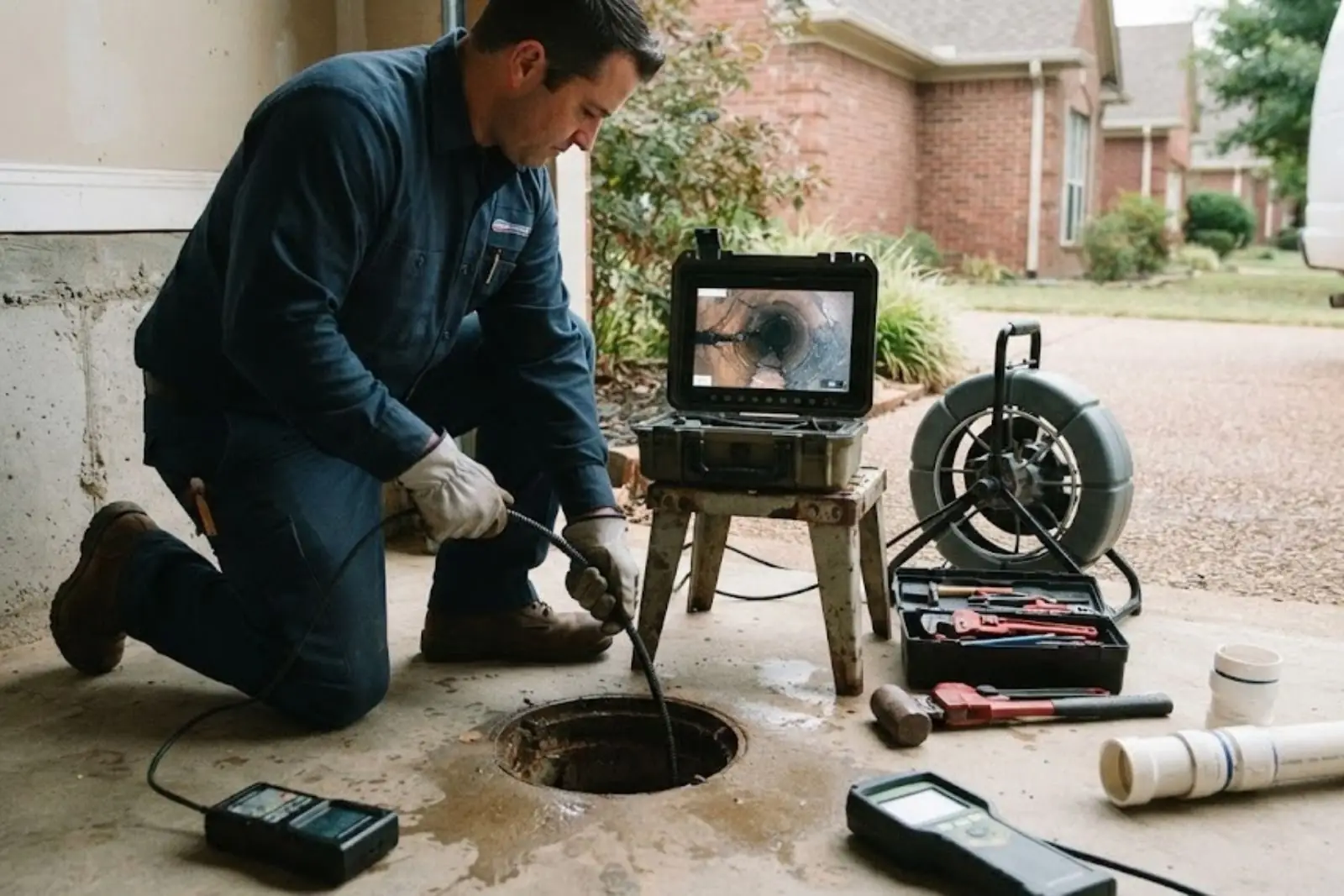
Who should schedule a camera inspection
The most common reason is a line that keeps clogging. Cabling clears the plug, the clog returns and nobody knows why. A camera shows the cause, whether it is roots, a low spot, a cracked joint or grease scale. It turns a guess into a plan.
The second reason is a home purchase. A sewer line is expensive to repair and invisible during a standard home inspection, so many buyers add a camera check to their due diligence period. Sellers sometimes order one first so surprises do not appear in negotiation. Homeowners planning a remodel or a landscaping project also benefit, since the report shows where the line runs and how deep it sits.
How the inspection works
We locate the cleanout, or pull a toilet or open a vent if none exists. The camera head is on a flexible cable with lights and a distance counter. It travels down the line toward the street connection while the video records. At any defect, we pause, mark the distance and note the finding.
A locating transmitter in the camera head lets us trace the line on the surface, so we can mark where it runs and how deep it lies. That information helps with repair plans and with decisions about trees, fences and additions. When the run is complete, we review the video with you on the spot.
What the camera can show
Different conditions look different on the screen. This is what we report and how serious it usually is.
| What we see | What it usually means | Typical next step |
|---|---|---|
| Root hair at joints | Small openings letting roots in | Cut roots and plan a liner or joint repair |
| Standing water in a section (a belly) | The pipe has settled and holds waste | Monitor or replace the low section |
| Offset or separated joint | Ground movement pulled the pipe apart | Spot repair at the joint |
| Scale or heavy grease | Buildup narrowing the pipe | Clean with hydro jetting |
| Crack or collapse | Pipe structure has failed | Repair or replace, see sewer line repair |
Reading the footage like a buyer
A line that has a few roots or light scale is normal for an older home and rarely needs immediate work. A line with a belly, an offset or a crack deserves a quote before closing. If the inspection finds a collapsed section or fiber pipe, the cost of repair may become a negotiating point.
We give you the video file and a written summary so you can share them with your agent or lender. We describe what we see and do not make guarantees about what lies beyond the camera's reach. If the camera cannot pass a blockage, we say so and recommend cleaning first.
Limits of the camera, honestly stated
A camera sees the inside of the pipe, not the soil around it. It cannot measure the strength of cast iron or predict when a pipe will fail. Dirty water, a full line or a belly can block the picture. In those cases, we clean the line and try again, which is why some inspections begin with a cable pass.
We also tell you what we cannot see. If the line connects to a septic tank, the camera inspection covers the line, not the tank. A septic system needs a separate inspection by a qualified septic contractor.
Need a sewer inspection report?
Call us to book a camera visit. Tell us if the inspection is for a home sale so we can plan the report.
What affects the price of an inspection
A clear price is given before the camera goes in.
Insurance usually does not cover inspections, though a claim for sewer backup may include one. Call (208) 679-8357 for a clear price. Findings are described in plain terms, and any repair that follows is built to the Uniform Plumbing Code (UPC).
Sewer inspection questions from Post Falls homeowners
Usually an hour or two for a typical residential line, longer if the line has to be cleared first.
Yes. We give you the recording and a short written summary of the findings.
Not normally. Standard home inspections do not include the underground sewer line. A separate camera inspection is the usual way to check it.
Often yes. We can access it through a toilet, a floor drain or a roof vent. We may suggest installing a cleanout for future access.
We explain the options and the price. If it is a clog, see drain cleaning. If the pipe is damaged, repair or replacement follows.