
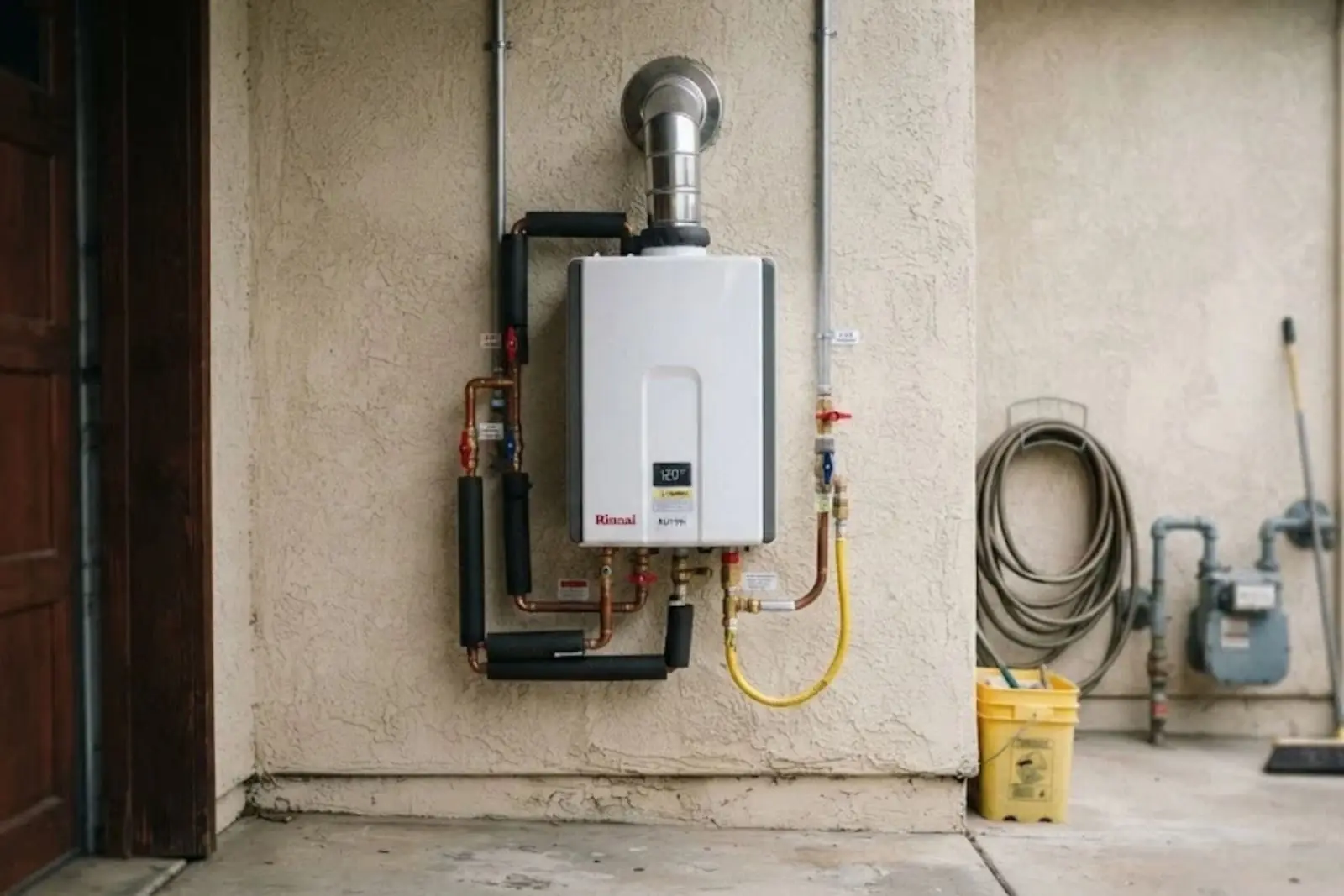
Is tankless right for your home?
Tankless heaters warm water as it flows through a heat exchanger, so they never run out and take up a small wall footprint. That is a real advantage in a busy household or a small utility room. The cost is higher up front, and the unit must be fed enough gas or electricity to heat a lot of water in seconds.
A gas tankless unit often needs a larger gas line than a tank does, and a venting system built for the condensing or non-condensing model. An electric unit may need a large dedicated circuit and a panel with room for it. If your house cannot supply either without costly upgrades, a tank or hybrid heat pump may be the smarter choice. Our water heater installation page covers the options.
Flushing and descaling: the service tankless owners overlook
Minerals in the water leave scale inside the heat exchanger, and scale restricts flow and insulates the metal. A scaled exchanger overheats, throws error codes and loses efficiency. The fix is a flush. We close the supply valves, connect a pump and hoses to the service ports and circulate a descaling solution through the exchanger for the time the manufacturer specifies, then rinse and clean the inlet screen.
Homeowners often ask about vinegar. White vinegar is a mild acid and is sometimes used for flushing, but strength, contact time and the effect on seals and the heat exchanger vary by brand, so follow the manual.
Units without isolation valves need a retrofit before they can be flushed at all. Many manufacturers recommend a yearly flush, and the right interval depends on your water, which is why we suggest testing your tap and asking the Post Falls Water Division for its quality report instead of guessing.
Common tankless problems and what we do
Error codes differ by brand, but the underlying causes fall into a few families.
| Symptom | Likely cause | Typical fix |
|---|---|---|
| Water turns cold midway through a shower | Scale in the exchanger or a flow sensor under its threshold | Flush and clean the inlet screen |
| Error code on the display | Ignition, venting, flame or sensor fault | Diagnose the code, clear the vent, replace the sensor |
| Burst of cold water between uses | Crossover plumbing or a recirculation fault | Check for a bad mixing valve or a crossed line |
| Unit trips the breaker or cuts out | Electric unit overloaded or element failure | Check the circuit and the elements |
Gas, venting and condensate
Condensing gas models pull so much heat from the exhaust that they produce acidic condensate, which has to drain somewhere. A neutralizer cartridge in the line protects the drain pipe and the local sewer.
Vent pipe for these models is plastic and has strict length and slope limits. We check the vent run, the intake and the clearance from windows before we start, because a vent that is a few feet too long can derate the unit or trip a code.
In Post Falls the Building Division issues the permit and inspects the work, and the plumbing code in force is the 2017 Idaho State Plumbing Code. A permit is part of the scope when the work calls for it.
Cold winters and exposed units
Idaho winters are cold enough that an exterior or garage-mounted tankless heater needs freeze protection. Many units have built-in heaters that protect the exchanger, but they depend on power and gas staying on. A power outage during a hard freeze can freeze the unit and crack the exchanger.
If your heater is in an unheated garage or crawlspace, ask us about insulating the supply lines and the condensate pipe, and about what to do if the power goes out. A burst pipe after a freeze is something we handle on our burst pipe repair page.
Tankless cold or throwing an error?
Call our dispatch line. Troubleshooting by phone is part of the first conversation.
What affects tankless pricing
We give a clear price before work starts. The number depends on the following.
Insurance seldom pays for installation. Call (208) 679-8357 for a clear price based on your house. Gas lines and venting follow the Uniform Plumbing Code (UPC) and the manufacturer, and electric units follow the National Electrical Code (NEC).
Tankless water heater questions from Post Falls homeowners
Follow the manufacturer's interval, which is often once a year, and shorten it if you know your water leaves scale. We can test the flow and inspect the exchanger to tell you more precisely.
Yes. We service most brands. Some manufacturers have specialized parts or software, so we tell you early if a part has to be ordered.
It saves space and gives continuous hot water, and it can last longer than a tank when maintained. It also costs more to install and needs yearly service. It is worth it for steady demand and long-term plans.
Codes point to ignition, venting, flame, sensor or flow problems. We read the code, check the vent and clean the unit before replacing a part.
Yes, when the gas or electrical capacity supports it. See our replacement page for the decision framework.