
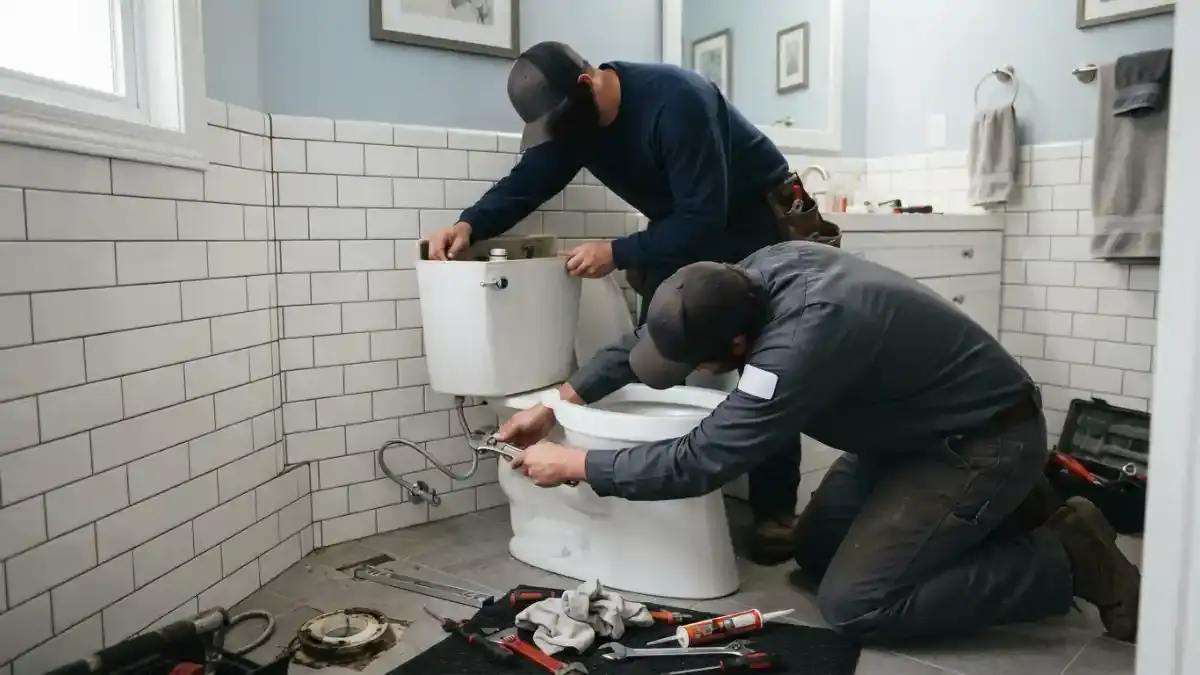
Overflowing toilet: first steps
If a toilet is rising toward the rim, lift the tank lid and push the flapper down, or turn the water supply valve behind the bowl clockwise until it stops. Do not flush again. Mop up the floor and ventilate the room.
- Close the supply valve behind or beside the toilet.
- Do not flush a second time.
- Use towels to keep water off the subfloor.
- If several fixtures back up, stop all water use and call, because the main line may be blocked.
Why toilets run, ghost flush and hiss
A toilet that runs is usually leaking from the tank into the bowl. The flapper, the rubber seal at the bottom of the tank, wears or warps, or the chain is too tight and holds it open. The water level may also sit too high and spill into the overflow tube. The fix is often a new flapper and a small adjustment.
A hissing sound means the fill valve is still letting water in. A phantom flush, where the toilet refills on its own every few hours, points to a slow leak past the flapper. A simple dye test confirms it. Drop a few drops of food coloring in the tank and wait twenty minutes. Color in the bowl means the flapper is leaking.
Symptoms and likely repairs
Most toilet problems fall into a few families.
| Symptom | Likely cause | Typical repair |
|---|---|---|
| Runs constantly or refills on its own | Worn flapper, long chain, bad fill valve | Replace flapper or fill valve, adjust the chain |
| Weak flush or slow bowl refill | Clogged rim jets or low tank water | Clean the jets, adjust the water level |
| Water around the base | Failed wax ring or loose bolts | Reset the toilet with a new wax ring |
| Rocks or wobbles | Loose bolts or an uneven floor | Tighten, shim and re-seal |
| Clogs often | Partial obstruction in the trap or drain | Auger the toilet, check the main line |
Clogged toilets: what works and what does not
A plunger with a flange cup handles most toilet clogs. Press slowly to seat the cup, then push and pull with steady strokes. A closet auger reaches the trap and clears what a plunger cannot. Chemical drain openers and long soaks in hot water can damage the bowl and rarely help.
If the toilet clogs again right away, or if the tub and sink gurgle when the toilet is flushed, the problem is beyond the bowl. A partially blocked main line or a vent problem produces that pattern. See sewer line cleaning and drain cleaning for the next steps.
Leaks at the base and the wax ring
A toilet is sealed to the drain by a wax ring or a rubber gasket. When the seal fails, water leaks at the base during a flush, soaking the floor and sometimes the ceiling below. A soft spot in the floor or a stain on the ceiling is a sign that the leak has been running a while.
The repair means pulling the toilet, inspecting the flange and the floor, replacing the ring and resetting the bowl. A damaged flange or rotted subfloor needs to be repaired first. We look at the floor before we reinstall, so the new seal does not fail for the same reason.
Repair or replace?
A toilet that has needed several repairs, cracks in the porcelain or constant clogs is often better replaced. Newer toilets use less water per flush and can fit a smaller footprint. Comfort height models are easier on knees and backs.
If you are buying a toilet yourself, check the rough-in distance, the measurement from the wall to the center of the drain, which is commonly twelve inches. We can measure it for you before you shop. Our plumbing installation page covers other fixture upgrades.
Toilet trouble? Call us
Overflow, leak or constant running, we can send a plumber day or night.
What affects toilet repair pricing
We explain the price before work begins.
Insurance may cover water damage from a sudden overflow but not the toilet itself. Call (208) 679-8357 for a clear price. Replacement toilets follow the Uniform Plumbing Code (UPC) and the federal flush volume limits, and WaterSense labeled models meet a stricter flush limit.
Toilet repair questions from Post Falls homeowners
Yes. The 24/7 line is open at all hours. We send a licensed plumber and tell you how to stop the water while we travel.
Most often the flapper is worn or the chain is too tight. The fill valve may also be failing. We diagnose it and replace the part.
We do not recommend it. Chemicals can damage the bowl and are dangerous to the next person who handles the water.
Typically one to two hours when the flange and floor are sound.
It can waste a lot of water over a month. Fixing it is usually quick and inexpensive.