
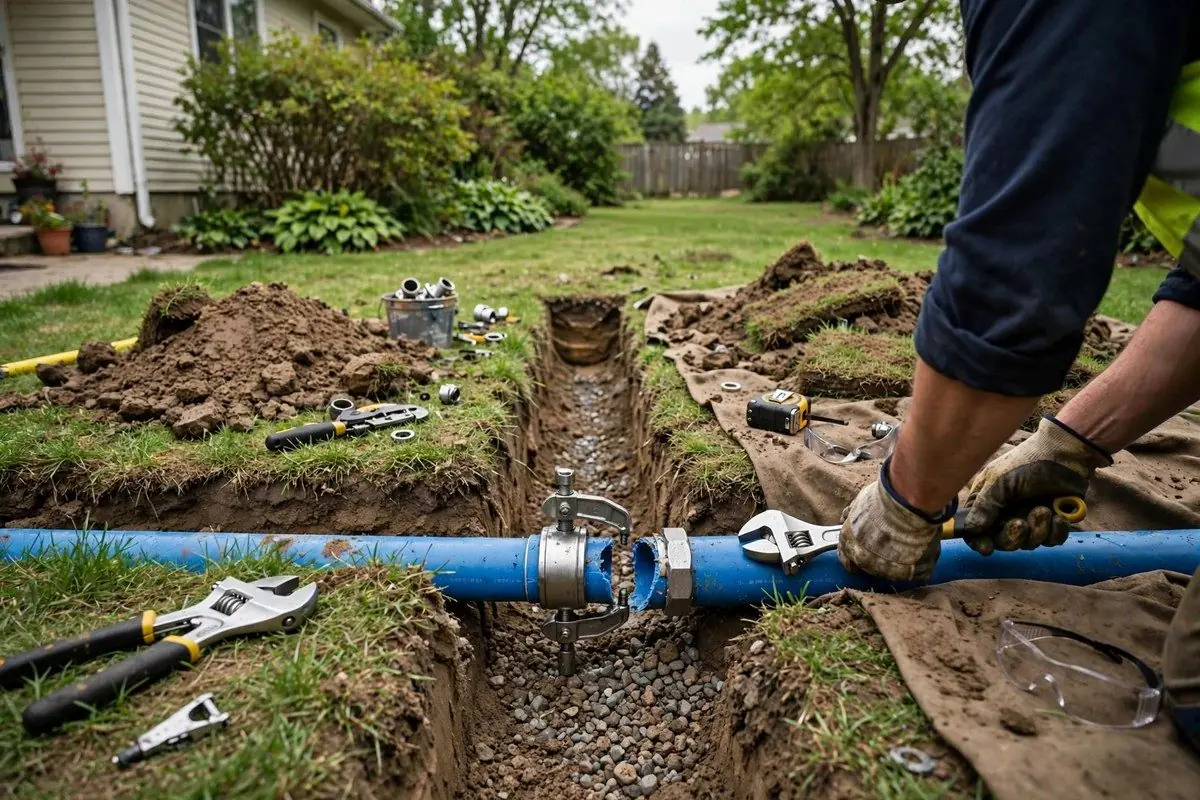
Signs your service line is failing
Look for a wet patch or a lush strip of grass above the line, a hissing sound near the meter, water that is cloudy or discolored after a repair, and a bill that keeps climbing. If the pressure drops at every fixture at once, the problem is upstream of the branch lines in the house.
The meter test described on our leak detection page helps confirm whether the leak is on the house side or the service side. A soaked yard, a sinkhole or a new wet area at the curb tells you where to start.
Who owns what: the City side and your side
In most systems, the water utility owns the main in the street and the meter, and the homeowner owns the line from the meter into the house. The exact point varies, so confirm it with the utility. In Post Falls the Water Division can be reached at (208) 777-9857 and can tell you where your responsibility begins.
That distinction matters for cost and for permits. A leak on the City side is reported to the Water Division. A leak on your side is yours to repair, and we do it. If you are not sure, call the Water Division first, and call us if the leak is on your side.
Repair or replace the line
The choice depends on how much of the line is failing.
| Situation | Likely approach | Notes |
|---|---|---|
| One leak at a fitting | Spot repair | Quick when the line is otherwise sound |
| Several leaks along the line | Replace the run | Repeated repairs rarely last |
| Old galvanized or lead-era line | Replace the run | Corrosion limits flow and quality |
| Line under a driveway | Trenchless where possible | Avoids cutting concrete |
| Line passing under a tree or fence | Plan the route first | Roots and structures may call for a reroute |
Low pressure: the pressure regulator and the main valve
Low pressure has more causes than a leak. A partially closed main valve, a clogged strainer, a failing pressure reducing valve or scale-choked old pipes all reduce flow. We measure static pressure with a gauge and test flow at several points before deciding what is wrong.
Pressure that is too high is also a problem. Above 80 psi, fittings, hoses and water heater relief valves wear faster. A reducing valve set to a safe range, with an expansion tank where needed, protects fixtures. Normal service in most homes falls between 40 and 80 psi.
Backflow, shutoff valves and what protects your water
A backflow preventer keeps contaminated water from being drawn back into the supply. Irrigation systems and some outdoor connections commonly need one, and many need an annual test by a certified tester. A failed assembly leaks, spits or fails the test and needs repair or replacement.
The main shutoff valve at the house should turn easily. A valve that is stuck, leaking at the stem or has not been turned in years is a hazard when a pipe bursts. We replace failed valves with full-port ball valves that are easier to operate and last longer. For burst situations, see burst pipe repair.
What to do if the line is leaking right now
A leaking service line can wash out soil and flood a yard or a basement. These steps limit the damage until a plumber arrives.
- Close the main valve at the house, which stops water from the house side.
- Look at the meter and note whether the dial is still moving.
- Keep people and pets away from soft or sinking ground.
- Do not dig near the line yourself, since buried gas and power lines may be close.
- Call the Water Division if the leak is on the street side of the meter.
Digging, locates and restoring the yard
Before any dig we call Digline, Idaho's one-call utility locating service, so that gas, power and telecom lines are marked. We then choose the route that does the least damage. Trenchless methods can replace a line with two small pits when conditions suit.
After the work, we backfill and compact the trench and leave the surface level. Landscaping and concrete restoration are separate trades, and we explain what is included. If your line passes under a driveway, we plan around it and tell you what to expect.
Leak at the line or low pressure?
Call us and tell us what you have noticed. We will explain the tests we will run.
What affects water line pricing
We give a clear price before digging begins.
Insurance seldom pays for a worn service line, though some policies sell line coverage as an add-on. Ask your agent. Call (208) 679-8357 for a clear price. Service line materials, depth and backflow protection follow the Uniform Plumbing Code (UPC).
Water line questions from Post Falls homeowners
The homeowner usually owns that part. Confirm the exact point with the Water Division at (208) 777-9857.
Close the main valve at the house and watch the meter. If the dial still moves, the leak is between the meter and the house.
Often with trenchless methods when the route and soil suit. We explain the options after a site look.
A partly closed valve, a failing regulator or a leak can reduce it. We test it before suggesting a repair.
Usually yes. We pull it, as covered on our plumbing installation page.