
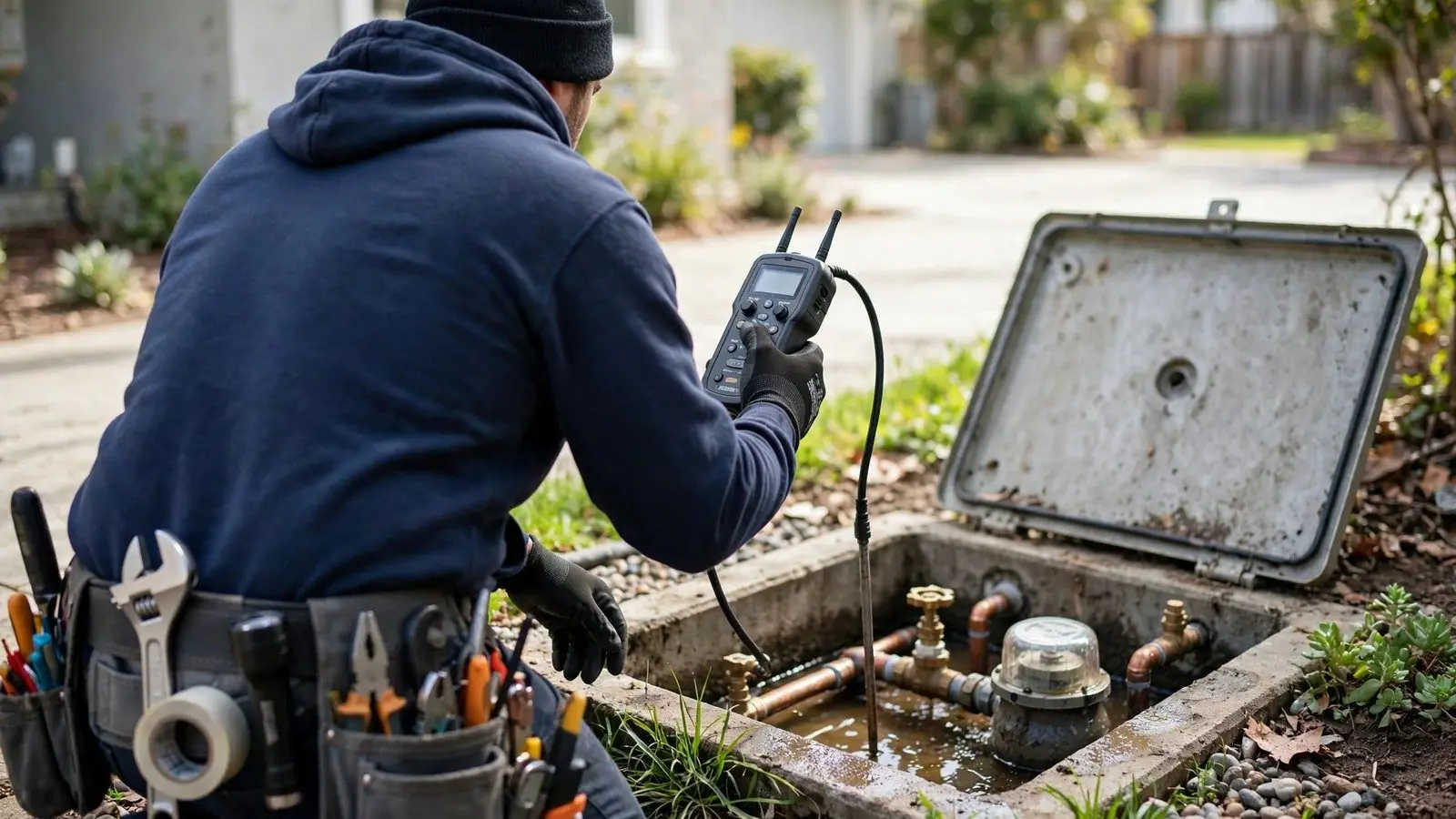
The sound of a leak
Water under pressure makes noise as it escapes a pipe. The escaping stream hisses, and the sound travels along the pipe and through the ground or the slab. A sensitive microphone placed on the floor, a fitting or the ground picks up the sound, and an amplifier and headphones let the technician hear it.
The sound is loudest right above the leak. By taking readings at several points along the line, the technician narrows the location to a few feet. Some equipment adds a correlator, which compares the sound at two points and calculates the distance to the leak.
What it works best on
Acoustic detection works best on pressurized supply lines, whether copper, PEX, galvanized or plastic. It is effective under slabs and in buried lines, where the leak cannot be seen. A steady leak at a fitting or a pinhole in a copper pipe makes a clear signal.
It is less useful on drain lines, which carry water only part of the time and are not under pressure. It also struggles with very small leaks, very deep lines and plastic pipe, which carries sound poorly. In those cases, other methods fill the gap.
Signs that point to a hidden leak
Some signs are loud and some are quiet. A water bill that climbs with no change in habits is the most common. A meter that moves when every fixture is off, the sound of running water in a quiet house and a floor that feels warm in one spot all point the same way.
Others show up in the house itself. Look for stains on ceilings, bubbling paint, a musty smell in a closet or crawlspace, and flooring that cups or lifts. Any one of these can have another cause, such as condensation or a roof leak, but together with a rising bill they justify a search.
Acoustic and other methods
No single tool finds every leak. A good technician combines methods.
| Method | Good for | Limits |
|---|---|---|
| Acoustic listening | Pressurized lines under slabs and in the ground | Noise interferes, plastic pipe is quiet |
| Pressure test | Confirming a leak and isolating a zone | Does not locate the leak |
| Thermal imaging | Hot water leaks in slabs and walls | Needs a temperature difference |
| Moisture meter | Finding wet drywall, wood and subfloor | Shows moisture, not the source |
| Tracer gas | Small leaks in sealed systems | Specialized equipment |
What to do before a leak detection visit
A little preparation makes the work quicker and more accurate.
- Do the meter test, with all fixtures off, and note whether the dial moves.
- Turn off irrigation, ice makers and softeners so they do not add noise.
- Keep the house quiet and the area around the suspected leak clear.
- Note when you first saw damp spots, stains or a rising bill.
- Tell the technician about any earlier repairs or pipe materials you know.
What happens after the leak is located
Finding the leak is the first half. The repair depends on where it is and how the pipe runs. A leak in an accessible crawlspace is a short repair. A leak under a slab may need the slab opened, or a reroute of the line through the attic or walls.
A technician will mark the location, explain the options and give a price before opening anything. If several leaks have already appeared in the same line, a replacement may cost less than repeated repairs. Our repiping page explains that decision.
Leaks, meters and gravel soil around Post Falls
The Post Falls Water Division can look at what your meter has recorded, and you can reach it at (208) 777-9857. Post Falls sits over the Rathdrum Prairie, a gravelly, fast-draining landscape, so water from a buried leak can disappear downward and leave the surface dry.
A lawn that stays dry does not prove the line is sound. Before any digging, Idaho's Digline service has to mark buried utilities. Repairs after a leak is found follow the Uniform Plumbing Code (UPC). If your leak is on the east side of the lake city, our Coeur d'Alene dispatch page explains how we reach you.
Common myths about leak detection
One myth is that a leak always shows as a wet spot. Water can travel along pipes and framing before it appears, so the stain on a ceiling may sit several feet from the source. Another is that a leak is always loud. A slow pinhole may make only a faint hiss that a person cannot hear but a sensitive microphone can.
A third myth is that detection means tearing up a floor. The point of the method is to avoid that. A good search narrows the location first, so the repair opens a small area instead of a whole room. Ask the technician how they plan to confirm the spot before anything is cut.
What to keep from the visit
Ask for a short written note of where the leak was found, how it was confirmed and what the options are. Keep any photos or readings with your home records. If you later sell the house, a note showing that a leak was found and fixed properly is a useful part of the file.
If your insurer is involved, the same note helps with the claim. It shows the cause, the location and the date, which are the three facts an adjuster asks about first.
Think you have a hidden leak?
Call us. We use acoustic and pressure methods to find leaks with minimal digging.
Is professional detection worth it?
A rising water bill, a warm spot on a slab or a meter that moves with everything off are all good reasons to call. Finding a leak early limits the damage, the wasted water and the mold risk. Opening walls and floors at random costs more than a targeted search.
Our leak detection page explains how we work and what affects the price. If a pipe has already burst, see burst pipe repair. If you are in Coeur d'Alene, our Coeur d'Alene page explains how we dispatch from Post Falls.
Acoustic leak detection questions from Post Falls homeowners
Often yes, for pressurized lines. The sound travels through the concrete, and a microphone on the surface can locate the loudest point.
Less well, since plastic carries sound poorly. Other methods may be needed.
Only after the leak is located, and only at the spot where the repair is needed.
Close the main valve at the house and watch the meter. If it still moves, the leak is in the buried line.
Yes. A pressure test confirms the leak and helps isolate which zone it is in.