
Check what you have before you buy
Start under the sink. Note whether there is already a disposal mount and an outlet or a hard-wired connection. Look at the dishwasher drain connection, because the disposal has an inlet for it, and the knockout plug inside must be removed if a dishwasher hose connects there.
Then choose a unit. A half horsepower disposal works for a light household. A three-quarter or one horsepower unit grinds finer and runs quieter. Check that the mount matches. Many brands share a mount style, but not all, and adapters exist when the old flange does not fit.
Tools and materials
Gather these before you disconnect the old unit.
- Screwdrivers and a hex key.
- Slip joint pliers and a bucket.
- Plumber's putty.
- A power cord kit if the unit does not include one.
- A new drain trap kit if the old one is corroded.
- A voltage tester to confirm the power is off.
Removing the old unit
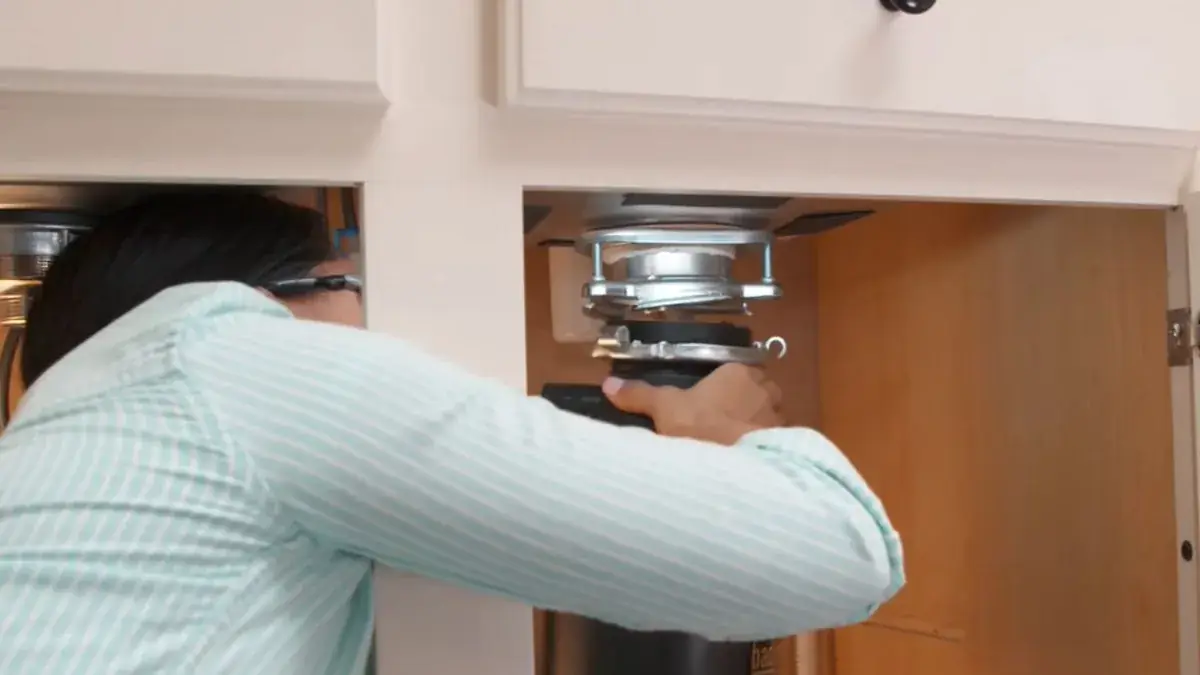
Turn off the power at the breaker, not just the wall switch, and confirm it with a voltage tester. Disconnect the drain pipe and the dishwasher hose, then twist the unit off its mount. Remove the mounting ring and the flange from the sink above, scrape off the old putty and clean the sink opening.
Take a moment to look at the trap and the drain line behind the unit. Old fittings corrode and leak when disturbed. If the trap looks tired, replace it now. A new disposal on a clogged line will back up quickly.
Installing the new unit
Press a ring of plumber's putty under the new flange and seat it in the sink opening. From below, fit the gasket, the backup ring and the mounting ring, then tighten the screws evenly until the putty squeezes out. Wipe off the excess putty from the top.
Wire the unit by connecting the black and white wires and the ground as directed, and use a cord with a strain relief. If you are hard-wiring, follow local code. Lift the disposal onto the mount, rotate it to lock, and connect the drain and dishwasher hose. Run water and check every joint for leaks before you use the unit.
Electrical options for a disposal
Wiring differs depending on what is in the cabinet. This is the usual pattern.
| Situation | Typical solution | Who should do it |
|---|---|---|
| Existing outlet under the sink | Plug in a cord kit | Capable homeowner |
| Existing hard-wired connection | Reconnect to the junction box | Homeowner who is comfortable with wiring, or an electrician |
| No power at the sink | New circuit or outlet and a wall switch | Licensed electrician |
| Dishwasher connected | Remove the knockout plug before connecting | Anyone installing the unit |
If your home uses a septic system
Some homes around Post Falls are on City sewer and others are on septic. If you have a septic system, ask whether a disposal is a good idea at all, since it adds solids to the tank and may mean more frequent pumping. Panhandle Health District regulates septic systems in Kootenai County, and its staff can answer questions about your system.
The City of Post Falls Building Division at (208) 773-8708 can confirm permit rules for plumbing work. Disposal wiring follows the National Electrical Code (NEC) and the drain connection follows the Uniform Plumbing Code (UPC). Coeur d'Alene homes have their own permit office, so the Coeur d'Alene page lists who to call there.
Testing and troubleshooting a new unit
Once the unit is mounted, run cold water and switch it on for a few seconds with nothing in it. Listen for grinding or rattling, which may mean a stray piece of packing inside. Check the joints under the sink with a dry paper towel, which shows even a slow drip.
If the sink drains slowly after the install, look at the trap and the drain line behind the unit. A trap that was not seated well or a line that was already partly clogged is the usual reason. If water comes up in the second sink bowl, the line behind the disposal needs clearing, and our drain cleaning crews handle that.
Safety habits while you work
Keep the breaker off until the unit is mounted, wired and closed up. Never reach into a disposal chamber, even when you think the power is off. Use a flashlight to look inside and a pair of tongs to remove anything stuck.
Wear eye protection when you scrape old putty, and keep a bucket handy for the water in the trap. Work with the cabinet door open and a light on, so you can see each joint as you tighten it.
Prefer to hand it off?
Call us. We install and repair garbage disposals and check the drain line behind them.
When a plumber is the better call
If the old unit leaks from the housing, the drain line is slow or the cabinet floor is soft, the job grows. Adding a disposal where there was none needs a power source, a switch and a drain modification. If you are not sure of the wiring, hire a professional.
Our garbage disposal repair and installation page explains how we handle both. If your kitchen sink backs up, check our drain cleaning page before you blame the disposal. If you are in Coeur d'Alene, our Coeur d'Alene page explains how dispatch works from Post Falls.
Using a new disposal well
Run cold water before, during and for a few seconds after grinding. Feed scraps in gradually, not in a heap. Keep grease, coffee grounds in quantity, fibrous vegetables and bones out of it.
A clean disposal smells better and lasts longer. Grind a handful of ice and a citrus peel now and then to freshen it, and never put your hand in the unit, even when it is off. If it jams, turn the power off at the breaker and use the hex socket on the bottom to free it.
Garbage disposal installation questions in Post Falls
Replacing a unit with the same type is within reach for many homeowners. Adding a new disposal needs power and drain work that may call for a professional.
Replacing a disposal often does not. New circuits and drain changes may. Call the Building Division at (208) 773-8708 to confirm.
Ask Panhandle Health District or a septic professional whether a disposal suits your system.
The disposal has an inlet that takes the dishwasher hose. Remove the knockout plug in a new unit before you connect the hose.
A half horsepower unit suits a light household. Larger motors grind finer and run quieter.