
Why a tankless heater needs flushing
Water carries dissolved minerals, and heating it makes those minerals settle out as scale. In a tank, scale falls to the bottom. In a tankless unit, it coats the heat exchanger, the narrow passage where water meets the flame or the element. Scale insulates the metal, narrows the flow and makes the unit work harder for less hot water.
The symptoms creep in. You may see longer waits for hot water, fluctuating temperatures, a flow sensor that cuts out or an error code on the display. A scaled unit also runs hotter inside, which shortens its life. A regular flush removes the buildup before it causes trouble.
What you need
The job needs a few specific items, and most of them are inexpensive.
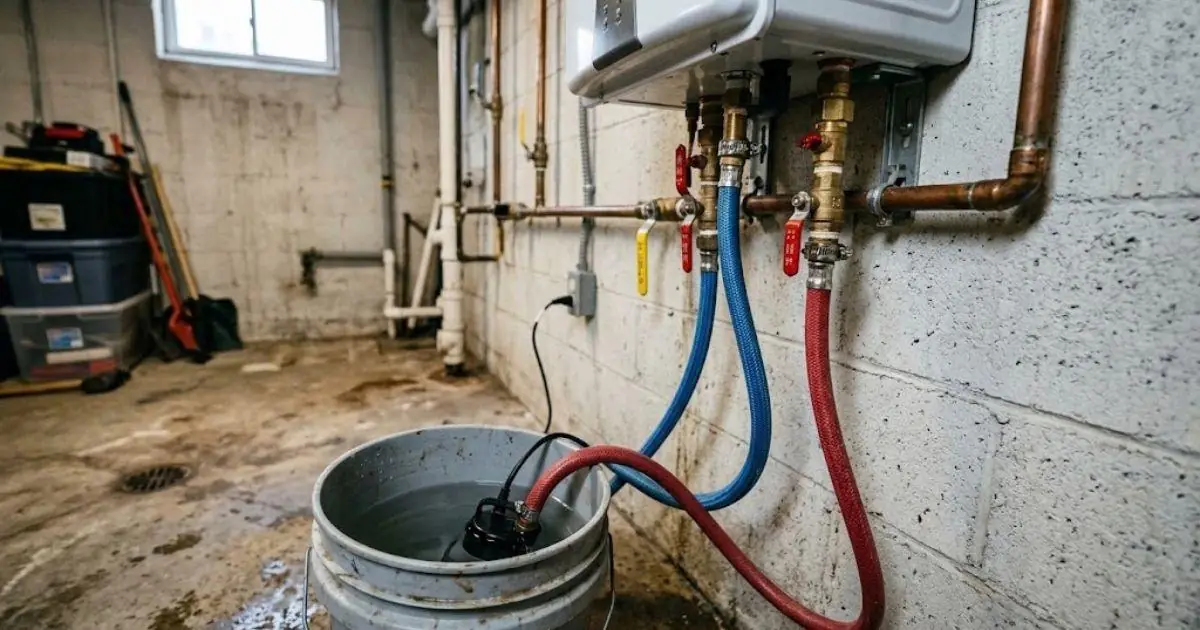
- A submersible pump with a short length of hose, rated for use with mild acid.
- Two washing machine hoses or similar hoses with the right fittings.
- A five gallon bucket.
- Several gallons of plain white vinegar.
- A garden hose for rinsing.
- The manufacturer's manual for the model.
Check for service valves first
The flush connects to a pair of service ports on the hot and cold lines under the unit. Many tankless heaters have isolation valves with caps. If yours does not, the heater cannot be flushed easily until a plumber installs them, and installing them is a common first service call.
Read the manual before you begin. Some manufacturers specify the flush time, the amount of vinegar and a limit on how long acid may sit in the heat exchanger. Others recommend a specific descaling product, and using something else can void a warranty. Follow the manual over any general advice, including ours.
The flush, step by step
Turn off the power or gas and close the main isolation valves to the heater. Connect the pump to the service ports with the hoses, with the discharge looped back into the bucket, and pour in enough vinegar to cover the pump. Open the service ports and run the pump so vinegar circulates through the exchanger for the time the manufacturer specifies, often around an hour.
Then drain the bucket, close the ports and rinse the unit by running clean water through it with the discharge hose open. Clean the inlet filter screen, since it traps debris that is often the source of low flow. Close the valves, restore power or gas, open the hot tap to purge air and test the unit.
Common mistakes and what they cause
Most damage comes from skipping a step or substituting a product.
| Mistake | What goes wrong | Better approach |
|---|---|---|
| Flushing with the gas or power on | Burner or elements can fire without water | Turn off power or gas first |
| Leaving vinegar in too long | Acid can attack seals and fittings | Follow the time in the manual |
| Skipping the rinse | Vinegar taste and smell in hot water | Rinse until the water runs clear |
| Forgetting the inlet screen | Debris keeps restricting flow | Clean the screen every flush |
| No service valves | The flush cannot be done safely | Have a plumber add isolation valves |
Water in Post Falls and your flush schedule
The right flush interval depends on your water, and we do not guess at the mineral content of any tap. The City of Post Falls Water Division publishes an annual water quality report, and you can request it at (208) 777-9857. A home test kit at your own tap gives a better guide to scale than a city average.
If you see scale on faucets or a white film on glassware, flush more often. Descaling instructions come from the manufacturer, and adding isolation valves is plumbing work covered by the Uniform Plumbing Code (UPC). Tankless owners in Coeur d'Alene can use our emergency plumber page for the lake city if a flush uncovers a failed part.
Signs the flush worked
After a good flush, the heater should reach temperature faster and hold it steadier. Error codes tied to flow or overheating should clear. The water from the first few taps may look cloudy or carry loose flakes of scale, which is a sign the descaling did its job.
If the flow is still weak, clean the inlet screen again and check the cold water supply to the heater. If the symptoms return within weeks, the unit may have heavier buildup than one flush can handle, or a part may be failing. Keep a short log of the date, the vinegar amount and the run time so a technician can see what has been tried.
Tankless acting up?
Call us. We flush, repair and install tankless heaters, and we can add isolation valves.
When to stop and call a plumber
If the flush does not restore flow, the heat exchanger may be too far gone for vinegar. A unit that still throws an error after flushing may have a failed sensor, a venting problem or a gas supply issue. Do not try to repair a gas component yourself.
A technician can flush with a stronger pump and the right descaling solution, test gas pressure and check venting. Our tankless water heater service page covers flushing, repair and installation. If the unit is older and failing, water heater replacement explains the decision between a new tankless and a tank.
Keeping a tankless heater healthy
Plan on a flush at least once a year unless your manual says otherwise, and sooner if you see symptoms. Keep the area around the unit clear and the vent unobstructed. In a cold climate, protect exposed lines and the condensate drain from freezing.
A water softener or a scale-reducing filter upstream can lengthen the time between flushes. If you are curious whether your water would justify one, see our water softener and filtration page and test before you buy. Customers in Coeur d'Alene can read how dispatch works on our Coeur d'Alene page.
Tankless flushing questions from Post Falls homeowners
Follow the manual, which often says once a year. Shorten the interval if you see scale on fixtures or flow problems.
It is widely used, but strength, contact time and seal compatibility vary by brand. Check the manual and follow its instructions.
Not easily. A plumber can add isolation valves, which makes this and future flushes simple.
The cause may be a failed sensor, a clogged inlet screen, a venting problem or a gas supply issue. A technician can diagnose it.
Yes. Exposed units and condensate lines can freeze in a hard cold snap, so protect them and keep power and gas on.