
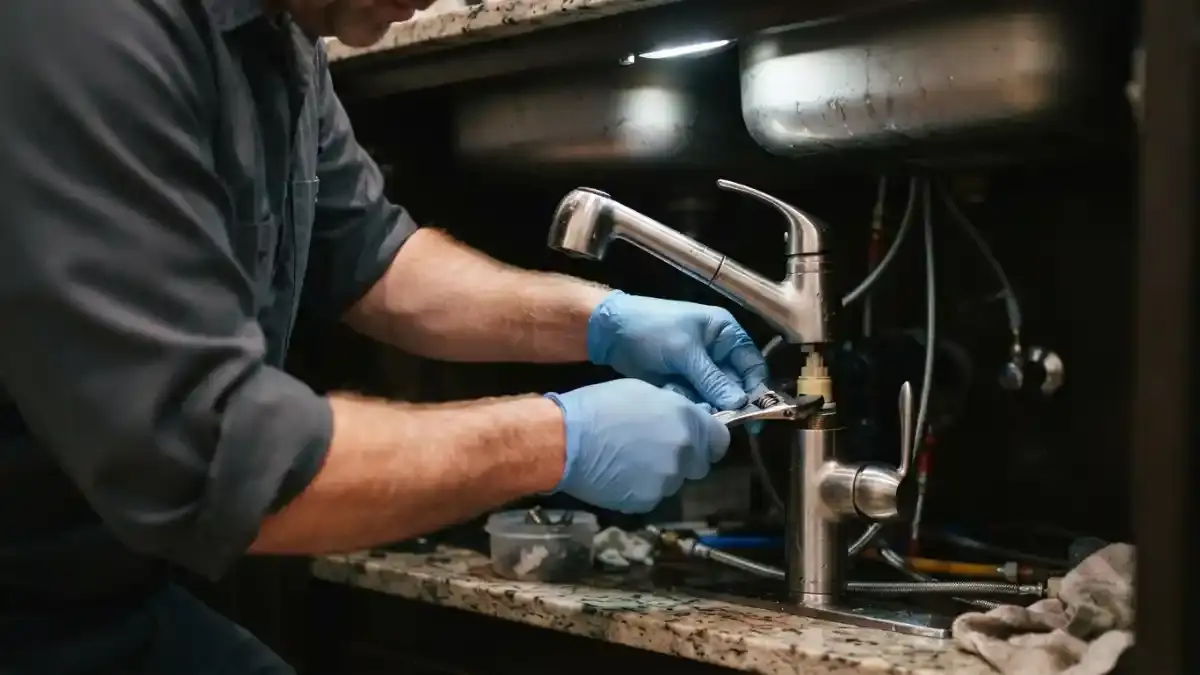
Why faucets drip
Most drips come from a worn seal inside the faucet. In a compression faucet, the rubber washer wears and no longer closes against the seat. In a cartridge, ball or ceramic disc faucet, a seal or the cartridge itself wears out. Mineral buildup can roughen the seat and make the leak worse.
Water pressure also matters. High pressure wears seals faster, and a faucet that was fine for years can start to drip after a pressure change. We measure pressure with a gauge when a faucet fails early, so we can tell whether the problem lies in the faucet or in the system.
Faucet types and typical repairs
The right fix depends on the design inside the handle.
| Faucet type | Common failure | Typical repair |
|---|---|---|
| Compression (two handles) | Worn washer or seat | Replace washers, resurface the seat |
| Cartridge (single or double) | Worn seals or a cracked cartridge | Replace the cartridge |
| Ball (single handle) | Worn springs and seals | Replace the rebuild kit |
| Ceramic disc | Cracked discs or mineral buildup | Replace the cylinder |
A faucet more than fifteen years old, with corroded fittings, is usually better replaced than rebuilt.
Repair or replace the faucet
A repair makes sense when the faucet is in good condition and parts are available. Replacement makes sense when the finish is worn, parts are hard to find or the faucet has failed more than once. Newer faucets also offer lower flow rates, better spray patterns and pull-down sprayers.
If you have already bought a faucet, show us the box and we will check that it fits your sink holes and supply lines. Single-hole, three-hole and wall-mount faucets are not interchangeable without changes to the sink or countertop. We test the installation before we leave.
Shutoff valves and supply lines
The small valves under a sink are meant to let you stop the water at one fixture. Older valves often seize, leak or fail to close fully when they are turned for the first time in years. We replace them as part of a faucet job when they fail the test.
Braided supply lines last longer than rigid ones but are not forever. A line that is kinked, stained or older than a decade is a candidate for replacement. A burst supply line is a common cause of flooded cabinets, and it is the kind of failure that can be prevented for a small price. If one has already burst, see burst pipe repair.
Outdoor spigots and winter
Hose bibs in North Idaho need extra attention in fall. A hose left connected holds water inside the faucet, and a hard freeze can split the pipe inside the wall. The split may not show until spring, when the faucet is turned on and water sprays into the wall.
Disconnect hoses before the first hard freeze, close the interior shutoff to the outdoor line if one exists and drain the faucet. Frost-free spigots help but work only if the hose is disconnected. If a hose bib is leaking inside the wall, call us and shut the supply to the house.
Low flow and spitting faucets
A faucet that sputters or has low flow often has a clogged aerator or cartridge. Sediment from the line collects in the screen at the tip of the spout, and a quick cleaning restores flow. If only the hot side is weak, the water heater or a hot supply line may be the cause.
If every fixture in the house has low flow, the problem is elsewhere. A partially closed main valve, a failing pressure regulator or a problem in the line can reduce pressure everywhere. Our water line repair page covers that case.
Faucet dripping or leaking? Call us
We can repair or replace it and check the valves underneath.
What affects faucet repair pricing
We give a clear price before work starts.
Insurance seldom covers a worn faucet, though a sudden supply line burst may be covered. Call (208) 679-8357 for a clear price. Faucet installation follows the Uniform Plumbing Code (UPC), including air gaps and backflow protection where they apply.
Faucet repair questions in Post Falls
If the faucet is in good condition and parts are available, repair is fine. A faucet that has failed repeatedly or has a worn finish is better replaced.
It depends on the rate of the drip, but even a slow drip adds up over a month. Repairs usually pay for themselves.
Yes. We check that it fits your sink and that the supply lines are in good condition.
Yes. We replace old or failing valves when we do faucet work.
Close the supply to the line if you can and call us. See leak detection if the source is unclear.